






Australia
Canada
U.S.A
The United Kingdom
New-Zealand
Europe and Other
Overview of the United Kingdom
The United Kingdom of Great Britain and Northern Ireland, commonly known as the United Kingdom or the UK, is a sovereign state located off the northwestern coast of mainland Europe. It is comprised of four neighbouring island countries: England, Scotland, Wales and Northern Ireland.
Although England, Scotland, Wales and Northern Ireland are “nations”, they are not officially independent countries. Instead, they are part of the country of United Kingdom (UK)—and bound by the UK constitution. Each of the four UK countries have local governments, which manage local affairs, such as healthcare and other social services. A democratically-elected UK government oversees all national and international affairs, including student visas and other education-related regulations.
The capital city, and the largest city of the UK, is London. It is also the capital of England. The capital of Scotland, Wales and Northern Island are Edinburgh, Cardiff, and Belfast respectively.
The population of the UK is 67.7 million people (2019 estimate). The UK is a highly multicultural country, made up of people from many different cultural and religious backgrounds. In fact, nearly 15% of the residents identify themselves as an ethnic minority.
Why Study in the UK?
The UK is famous for academic excellence. It provides students an opportunity to get world-class education, access cutting-edge research, and learn from the brightest minds. Students get the knowledge and skills that employers want—all while enjoying a high quality of life!

Get World-Renowned Education
One of the biggest reasons students choose to come to the UK is its world-renowned reputation for academic excellence. The UK universities consistently rank amongst the best in the world. In fact, three of the top 10 universities in the Times Higher Education (THE) World University Rankings 2022 are British. The high quality of education can be found right across the country, with over 20 universities across the UK ranking amongst the top 200 universities in QS World University Rankings and ShanghaiRanking’s Academic Ranking of World Universities as well.
Higher education institutions in the UK are regulated by the British government to maintain their globally-recognized, high standard of education—and to ensure that students get the best teaching, support and resources.
Access Cutting-Edge Research
The UK is at the forefront of innovative research and emerging technologies, giving students exposure to insights and experiences that are high in demand around the world. Students in the UK have an opportunity to collaborate on groundbreaking research, get their hands on the latest technology, and learn from the brilliant thinkers who are amongst the best minds in their fields.
Benefit from Short and Flexible Courses
Academic programs (referred to as ‘courses’ in the UK) are generally shorter in the UK than many other countries. British students can earn a Bachelor’s degree after three years of full-time study, and complete a Master’s degree course in one year. In contrast, it can take a total of six to seven years to earn the same degrees in Canada and the USA. The shorter study duration helps to reduce overall tuition fees and accommodation costs, thus making the UK an attractive study option.
Furthermore, students can pick and choose from over 50,000 academic programs (referred to as courses in the UK) in more than 25 subject areas in the UK. British universities offer flexibility, allowing students to choose from different subject ‘modules’ and tailor their studies to suit their interests and career aspirations.
Enjoy High Quality Living
The UK is one of the most desirable places to live in around the world with its high quality of education, healthcare, transportation, infrastructure, and government services. According to the 2017 report, How’s Life? Measuring Well-being, by the Organization for Economic Co-operation and Development (OECD), the UK also has a higher environmental quality, social engagement, personal security and the chance for engagement with civic society than many other developed nations.
Improve Career Prospects
British education gives students the opportunity to develop the skills, knowledge, critical thinking, and connections to drive forward their careers. As a result, British degrees are recognized and respected globally. Whether the student chooses to apply for work in the United Kingdom with a Post Study Work Visa (PSW), or return to their home country, a degree from the UK opens many doors for them.
The UK Education System
The UK education system is divided into early years, primary education (up to Year 6), secondary education (Year 7-11), pre-university or further education (Year 12-13), and higher education consisting of undergraduate and postgraduate studies.
Since each of the UK countries have autonomy over educational issues, there are some minor differences in the education system in different parts of the UK.
Early, Primary and Secondary Education
In the UK, primary and secondary education encompasses Reception/Kindergarten to Year 11. Students begin their education at age 4, and typically graduate at age 16 with a General Certificate of Secondary Education (GCSE). GCSE is earned once students complete a set of standardized exams for their chosen subjects at the end of Year 11.
State schools and independent schools are two different types of schooling options available to students in the UK. Over 90% of British students study at state schools, which is governed and funded by the UK Department of Education, and are free to attend. Students can also study at fee-levying independent schools. These schools are not administered by the government, but must still adhere to the schooling standards set by the government.
- Prospective international students can apply to study at independent schools. State schools do not accept international students, except for the dependant children accompanying an adult international student.
Further Education
Full-time education is compulsory until age 18 in the UK. After completing secondary school at age 16, British students go on to attend a Further Education (FE) college for two years, referred to Year 12 and Year 13 of their education journey. Students can choose to attain academic qualifications which are required for admission into a university, or pursue vocational qualifications to go directly into the workforce. Admission is based on one’s GCSE scores.
- Further Education is equivalent to the final years of secondary school in the US, Canada and many other parts of the world. It is not a substitute for postsecondary education. Instead, it is often referred to as senior- secondary or pre-university education.
Further Education colleges may be large and comprehensive institutions with many study options, or specialized in certain areas of the study, such as Visual/Performing Arts colleges, and Agricultural/land-based colleges. There are also Sixth form colleges, which are dedicated to 16-19 year olds, and often connected to secondary schools to ease the transition between the two levels of studies.
Higher Education
Higher Education refers to degree education, and includes both undergraduate (Bachelor) and postgraduate (Masters and Doctoral) studies.
- Bachelor’s degrees are typically awarded after three (3) years of full time study in the UK. It will take four (4) years if the student adds a year of work experience in between their study terms, referred to as a sandwich year. Professional degrees, such as medicine, veterinary and architecture degrees, require five (5) years of study.
- Students can earn a Master’s degree in one year, while a Doctorate is typically completed in three to five (3-5) years.
- Students can also pursue an Integrated Master’s degree, a four-year that combines undergraduate and graduate studies. Students are admitted after A-levels (further education), and do not receive a Bachelor’s degree in the process.
Higher Education is typically offered by universities, though some Further Education colleges and institutes also award degrees and foundation degrees (a two-year degree) in partnership with a recognized body. A recognized body is a higher education institution that is recognized by British government through legislation, and authorized to award degrees in the UK.
Levels of Study and Qualifications
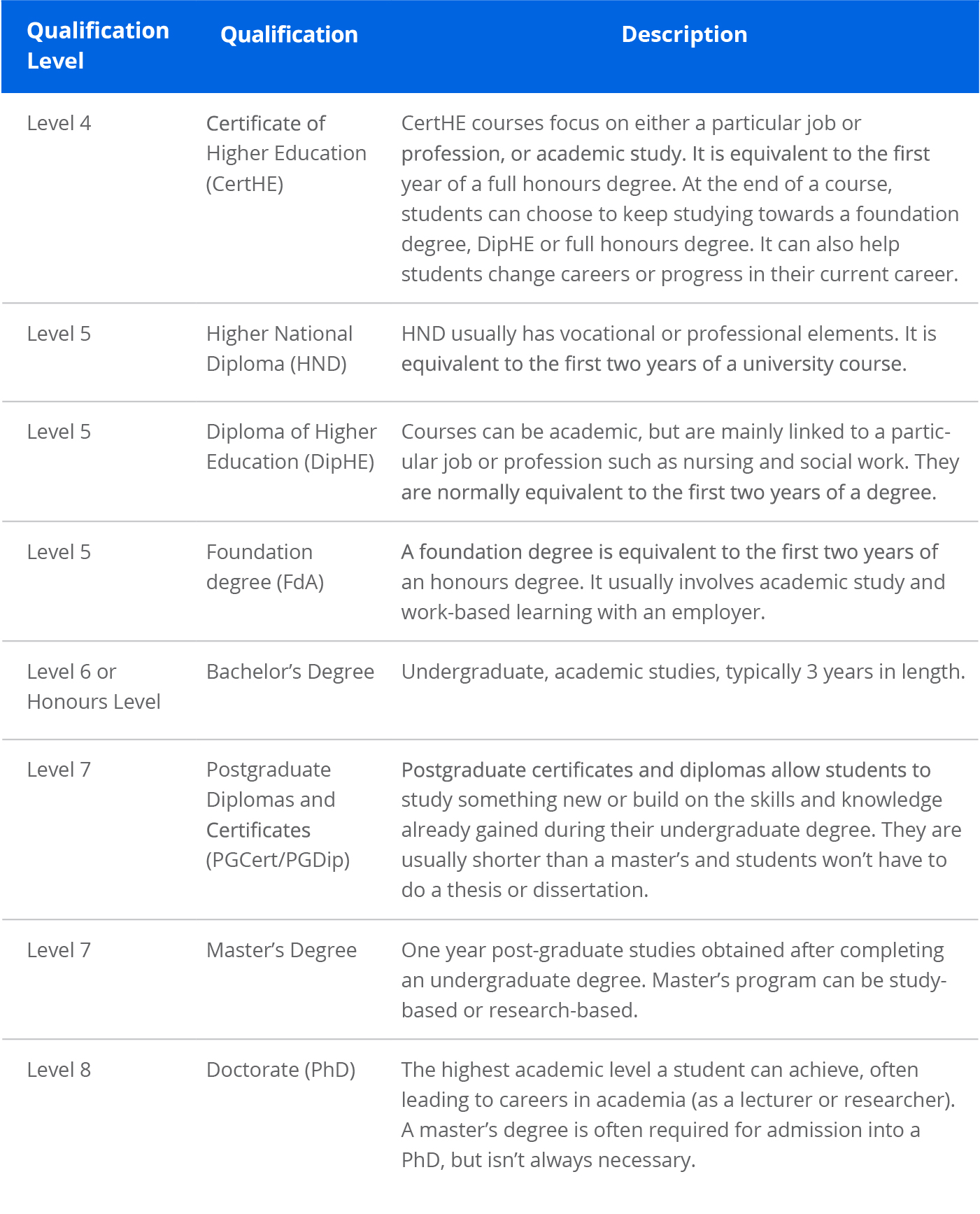
With over 50,000 courses to choose from, there is a wide variety of study options and qualifications that students can pursue in the UK to prepare themselves for their desired careers. The qualifications that students can earn fall into one of the eight levels that are established by the government based on the difficulty level.
Qualifications that are commonly pursued in the UK, and the levels they are at, are specified in the Ofqual Register of Regular Qualifications and outlined below.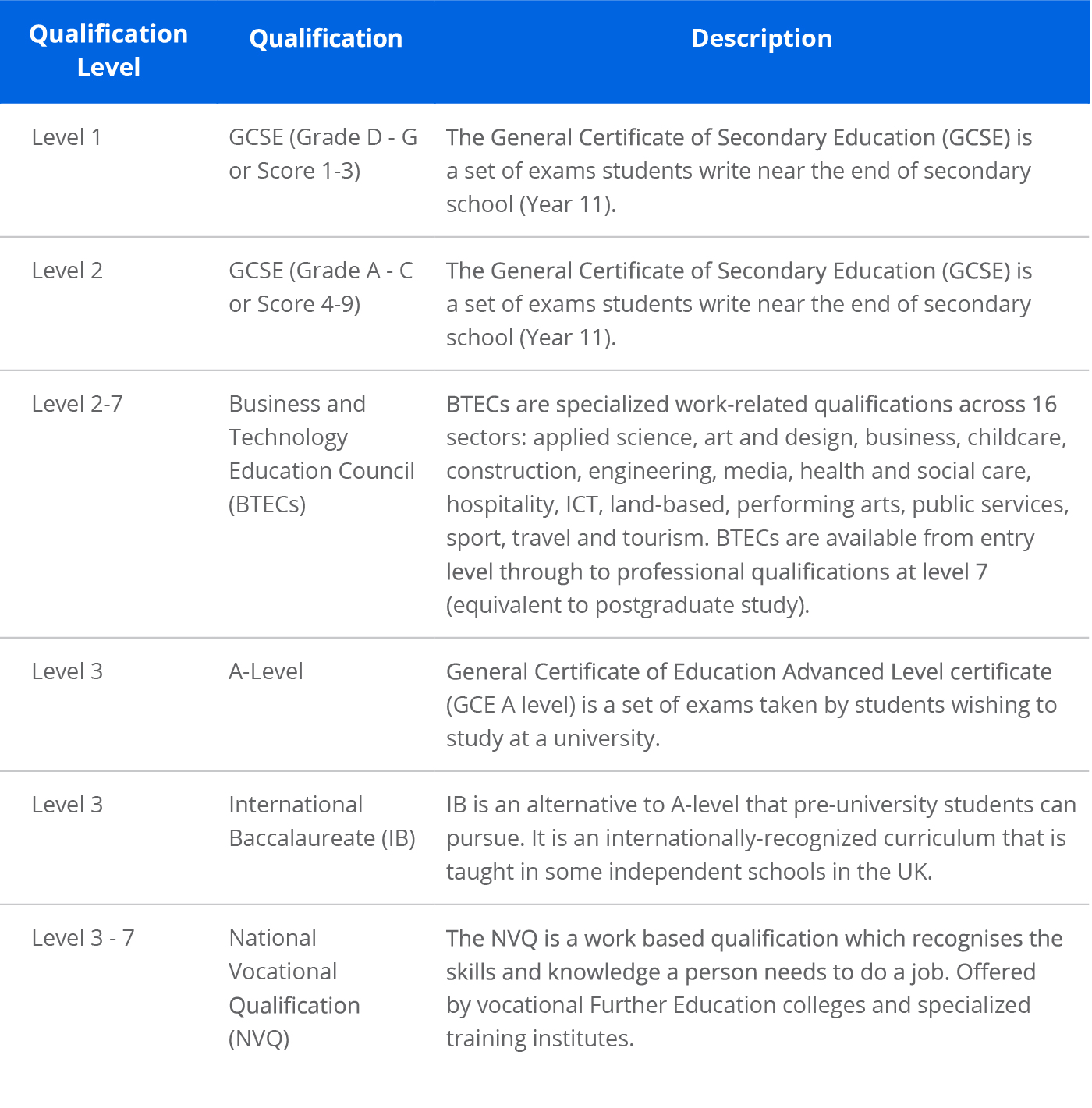
Foundation Programs

Students who wish to study in the United Kingdom may first take a preparatory course, also known as a foundation course or pathway program, to gain the academic or English language skills they need for admission to higher education courses. A pathway program is an introductory course that is completed before enrollment at a university in the UK. They are offered by British universities and colleges, as well as private study centres with university partnerships. Pathway programs are designed to help international students prepare for and gain access to UK university courses if they are not able to enter the university directly.
Below are the different kinds of pathway programs available in the UK for international students.
Pre-Sessional English
Pre-sessional English courses help international students prepare for the demands of learning courses taught in English at a university level. International students who complete pre-sessional English courses are more likely to meet the language proficiency requirements for course entry. Courses range from a few weeks to a term or a year in length depending on the student’s level of English proficiency. These courses also help students gain exposure to British culture, helping them overcome culture shock and settle into life in the UK.
Bachelor’s Preparation
In many parts of the world, students finish their secondary education after Grade 12 or Year 12. British students, on the other hand, do not begin undergraduate studies until after Year 13. As a result, many international students begin their British education with a one-year pre-university program known as International Foundation Year. International Foundation Year is equivalent in standard to qualifications studied in British schools’ Year 13 (i.e. A-levels) and includes academic subjects, study skills, and English language training. Over the year, students build the skills and knowledge needed to transition into the first year of their chosen undergraduate degree.
Note: In Scotland, undergraduate degrees are four years in duration and can accept students at a slightly younger age. Like the rest of the UK, Scottish universities also offer pathway programs.
Accelerated Bachelor’s Preparation
International Year One is an intensive 2-3 term program which is equivalent to the first year of an undergraduate degree. It is intended for international students who show academic potential but do not meet the requirements for direct entry into a degree program. Students enrolled in this program typically already have their A-levels (or equivalent). Participants study undergraduate first-year level subjects while receiving a higher level of academic and English language support. After completing this program, students may advance into the second year of their chosen undergraduate degree course and earn their degree at the same time as their local peers.
Pre-Master’s Program
Pre-Master’s programs provide international students with a direct path to postgraduate study at a university. These programs improve the academic skills needed for a full degree, such as academic writing and basic knowledge of academic terminologies. They also include study skills development and English language training.
To learn more about pathway programs, download these info sheets:
- Pathway Programs in the UK: Get more information about admission requirements, pathway providers, and employment options while taking the pathway courses.
- Types of Pathway Programs: Explore the different pathway programs available for international students and identify the one that best suits your needs.
Admission Requirements and Application Deadlines

Prospective students should begin reviewing the admission requirements far in advance to give themselves sufficient time to satisfy the admission requirements. This might include taking prerequisite courses they need, collecting required documents, writing applicable tests, and completing any other steps required to gain admission.
Admission Into an Independent School
As mentioned earlier, school-aged international students may study in the UK at independent school only. As such, this section only covers admission into independent schools, and not state schools.
The admission process at independent schools varies greatly from school to school. Some schools require interested students to take an entrance exam. Others may invite the student or the family for an interview. Some schools also hold assessment days, inviting students to participate in a series of activities to assess their suitability for the school.
While some schools operate on a first-come, first-served basis, many independent schools have strict admission deadlines that can fall as early as the beginning of the previous September (i.e. a full year before entry).
Admission Into a Higher Education Course
Universities and colleges set their own entry requirements for higher education courses, and these vary widely depending on the subject, the specific course, and the course provider. Admission is typically based on a student’s past academic qualifications. Some courses also require supplementary information from the student, such as an admission test, personal statement, resume, references and/or an interview to further assess a student’s suitability before making their admission decision. International students from non-speaking countries also need to demonstrate their English language proficiency through an English test.
Academic Qualifications
Education providers require students to have successfully attained prior levels of qualifications to ensure they will have the right skills and knowledge to complete their chosen higher education course. Students need to provide transcripts/marksheets to show they meet the academic requirements for admission.
For admission into undergraduate level university courses, prior completion of A-levels, Advanced Highers or equivalent-level qualifications is required. The marks that are considered acceptable varies by course and by institution. Higher marks are usually needed to gain admission into more competitive or in-demand courses. Most courses will also expect students to have some pre-16 qualifications, such as GCSE English and maths, or their equivalents. Students will also need to have taken subjects related to their chosen higher education course, known as prerequisite courses. For example, a student seeking admission into an Engineering program will need to have completed Grade 12-equivalent math courses.
Admission into a postgraduate Master’s program is dependent on prior completion of an undergraduate degree. Students applying for a Masters or Doctorate program must have a Bachelor. Many PhD programs also require students to have a Master’s degree first.
Personal Statement
Many colleges and universities require students to demonstrate their suitability for a specific course through a written personal statement. A personal statement should discuss:
- Interest in the course. Why has the student chosen the particular course? Why do they think they are suitable for the course?
- Skills and achievements. Any awards won, any positions of responsibility held, achievements student is proud of, attributes that make them interesting. Universities like to know the skills a student has that will help them on the course, or generally with life at university.
- Hobbies and interests. Students can use these to demonstrate their personality, skills and abilities. Try to link them to the skills and experience required for the course(s)
- Work Experience. Include details of placements, work experience, voluntary work, or jobs, especially if it is relevant to the chosen course(s).
- Gaps in Education (if applicable). Explain what the student was doing since leaving education
- Future Plans. What does the student want to do after their graduation? How will they use the knowledge and experience they’ll gain through the course? How does the course relate to what you want to do in the future?
- Why UK? Why does the student want to study in the UK and in the university they are applying tor.
Personal statements are a great way for a student to make themselves stand out over other applicants.
References
References should ideally come from someone who knows the student academically and can talk about their work ethic, interaction with other students and their suitability for higher education or a future career. These include:
- Teachers
- Principals
- Tutors
- Coaches
Past or current supervisors can also provide a reference, if a student left education years ago, or if students are applying for programs related to their work, such as if a student applying into a medical program was working or volunteering at the hospital, or if a student is applying for an MBA course.
Referees who supervised or coached a student in their volunteer positions or extracurricular activities, and can speak about a student’s work ethic, leadership, teamwork and intrapersonal skills are also often accepted. Friends and family members, on the other hand, cannot be used as references.
Interview
Many education providers will also invite shortlisted student for an interview before making their admission decision. Interviews can take place over telephone, video call, or in-person if a student is able to travel to the institution. A lot of British universities also have overseas teams, which hold interviews in major countries around the world. Interviewers will ask questions relating to the student’s background, current study plans, and future career aspirations. The interview also helps the university ensure that the student is coming to the UK for genuine study purposes and has a realistic prospect of returning home once their studies have finished.
Working as a Student and Post-Graduation Work
Many international students choose to work while studying to earn an income, as well as to gain valuable British work experience to support their professional growth.
Students with a valid Tier 4 Student Visa are eligible to work in the UK while studying. The number of hours a student is eligible to work will depend on the level of the education they’re pursuing. Students enrolled in a full-time program at degree level and above can work for a maximum of 20 hours in any given week. If they are studying below degree level, they may work up to 10 hours in a given week. Students can also full-time during vacation periods: winter, summer and spring holiday breaks when classes are not in session.
Note that students in a master’s program do not get summer vacation. They are expected to study full-time towards their dissertation in the summer, and cannot work full-time during this period. Postgraduate research (PhD) students do not have any specified vacation period. They are permitted up to six weeks of vacation per year, which they can take after getting approval from their supervisor or school.
A student’s Biometric Residence Permit (BRP) will specify any work restrictions a student has. Students should review their BRP when they receive it to verify all the information is correct. Learn more about the Biometric Residence Permit in the Student Visa section of the guide.
Financial Costs and Assistance
Studying in the United Kingdom can be an expensive undertaking. By being aware of all of the tuition and living expenses, and budgeting accurately, students can ensure they will have the financial means to complete their education.
Tuition Fees
The cost of studying in the UK varies by institution, the level of study, and the type of course. Science and engineering degree courses are generally more expensive than humanities, social sciences and other art courses.. According to the Reddin Survey of University Tuition Fees, international undergraduate tuition fees can range from £10,000 (~US$14,130) and to £38,000 (~US$53,700) or more for medical degrees.

Living Expenses
In addition to tuition, students must also account for housing, food, transportation and other day-to-day living expenses. Costs are generally higher in bigger cities, and also depend on a student’s lifestyle, choice of housing, and spending habits. London, in particular, has the highest cost of living in the UK—and students need to demonstrate higher financial capacity if they’ll be studying in England. Refer to the Student Visa Financial Capacity section of this guide for more information.
Housing Costs
Cost of accommodation varies depending on the type of accommodation a student chooses. Many students opt for living at their university’s residence halls during their first year to ease their transition into a new environment before moving into private accommodations off-campus in their following years.
On-Campus Housing
On-campus housing include shared and private bedrooms, though private bedrooms are more common at UK universities. When choosing to live in residence halls, students can choose between self-catered and catered residences. Self-catered halls include a kitchen shared by 10-15 students, where students can prepare their meals. On the other hand, catered halls of residence include a dining hall with a cafeteria where students can get their meals. The cost of food is included in the rental price.

Other Living Expenses
Students need to also account for the following expenses when planning their budget:

Financial Assistance
The majority of international students in the UK pay full fees for their studies. However, there are a number of scholarships, grants, and bursaries available to assist students with the cost of their education. They are offered by the government, education providers, and a number of other public and private organizations.
Some of the major scholarships available for international students are:
- A.S. Hornby Trust Scholarship: Available to English language teachers seeking to further develop their English language skills.
- Chevening Scholarships: Offered to outstanding students enrolling in a one-year master’s degree, and demonstrating high leadership potential. The scholarships cover the full-cost of tuition, flights and accommodation.
- Commonwealth Scholarships and Fellowships: Available to students from other Commonwealth countries.
- Marshall Scholarships: Offered to US students pursuing postgraduate studies in the UK. Students must hold a doctorate in a science or engineering subject by the time they take up their Fellowship, as well as leadership and ambassadorial potential.
- Scotland’s Saltire Scholarships: Available to students from Canada, China (including Hong Kong), India, Japan, Pakistan and USA. Students must be pursuing postgraduate master’s studies at Scottish universities in the areas of science, technology, creative industries, healthcare and medical science.
- University-specific scholarships and bursaries: Offered by the university to qualifying international students based on academic merit, leadership potential and/or financial need. Students should check out the websites of the universities they are interested in studying at for their list of scholarships.
For more information on available scholarships, bursaries and postgraduate funding opportunities, please visit the websites for British Council and the UK Council for International Student Affairs, and Postgraduate Studentships.